Commodity Business Operation Lifecycle
Advisory

Advisory Services

Business Process Optimization

Energy Risk Management

Software Selection

Program Management

Renewables

Power Purchase Agreement (PPA) Management

Data Analytics Enablement

Data Journey

Data Transformation

Data Driven Success

Data Transformation

Database Migration

Analytics & Reporting

RightAngle

Other CTRM Products

Managed Services

Allegro

RightAngle

Other CTRM Products

Expertise on Demand

Allegro

RightAngle

Other CTRM Products

Testing Services

Automation Tool For Allegro (ATA)

RightAngle

Other CTRM Products

Business Process Outsourcing

Allegro

RightAngle

Other CTRM Products

CTRM Journey

CTRM Journey

CTRM Training

CTRM Implementation

Allegro

RightAngle

EnTrade

CTRM Implementation

CTRM Upgrades

Allegro

RightAngle

Other CTRM Products

ISO Services
ERP and CRM Implementation

Salesforce

Life At ValueCreed

Consultant's Journey

Culture

Employee Training
Programs

Wellness

Entrepreneurship

Learn by Example

Workcation

Gaming Zone

Catalyst

Client Training

Client Training

Careers

Careers

Digital Transformation

Intelligent Automation

Cloud Services

RightAngle

Other CTRM Products

DevOps

RightAngle

Other CTRM Products

Accelerators & Platforms
A Connected ETRM Approach to Modernizing Operations

EnTrade Implementation Services

Transform Your ETRM Operations with Expert EnTrade Implementation

Ask most scheduling teams and traders how they actually get through a day, and spreadsheets come up fast. Alongside a legacy ETRM platform, a handful of manual handoffs, and processes that have grown up around the tools rather than the other way around. As trading volumes grow and physical networks get more complex, those workarounds start to cost real time and real visibility. Value Creed helps energy and commodities organizations fix this without ripping out the systems already running their business.

Common Challenges faced by Energy Trading Teams

Front Office operations involve far more than simply recording trades. Teams need to coordinate nominations, pipeline movements, storage, fees, plant requirements, actual volumes, balancing, and end-of-day positions, often across multiple systems and stakeholders. At a lot of organizations, that work still lives in spreadsheets or gets passed hand to hand between systems. The real problem isn’t a missing piece of software. It’s how to modernize physical operations without throwing everything else into disarray. That shows up as:

Fragmented Workflows

Trades, nominations, pipeline balancing, fees, actualization, and reporting each sit in their own corner, so nobody has a clean end-to-end view.

Too much manual work

Teams burn hours maintaining spreadsheets, moving data by hand, tracking pipeline details, and calculating fees that could largely run themselves.

Limited Visibility

When physical and trade data live in different places, getting a current read on positions, nominations, variances, and actual volumes takes longer than it should.

Complex Physical Operations

Pipeline networks, storage agreements, transportation arrangements, and plant-specific quirks are hard to capture cleanly in older systems or spreadsheets.

Integration Gaps

New scheduling capabilities still need to talk to existing ETRM platforms, market data, and other enterprise applications, without breaking accounting or reporting reports.

High Risk

Manual work and disconnected data mean more errors, less consistency, weaker audit trails, and slower turnaround on things that shouldn't be slow.

Play Video about vc-entrade-implementation-1
VIDEO

Want to Know Our Approach?

Comprehensive EnTrade Implementation Services

We combine CTRM and ETRM experience, integration know-how, and a proven implementation methodology to help organizations rethink how they manage commodities. We look at what’s already in place, how the teams actually work, and what the business needs, then figure out where new capability makes the biggest difference.

Modernizing
scheduling

We move scheduling out of fragmented, manual processes and into structured ETRM workflows, so operational teams get a system they can actually rely on.

Modeling complex physical operations

We configure the ETRM environment to handle the real complexity of physical operations, instead of leaving teams to patch it together in spreadsheets.

Connecting the ETRM landscape

We design the architecture so new scheduling capability sits alongside existing enterprise systems, keeping the systems of record, accounting, reporting, and downstream integrations intact.

Automating data and processes

Wherever information is still moving by hand, we look for the chance to automate it, tightening up the scheduling lifecycle across operations and the wider enterprise.

Owning the transformation

We stay involved from the first assessment through post-production stabilization. Getting the system live isn't the finish line. Getting it working for the people who use it every day is.

The Strategic Pillars behind EnTrade Implementation

Value Creed’s EnTrade Implementation Approach

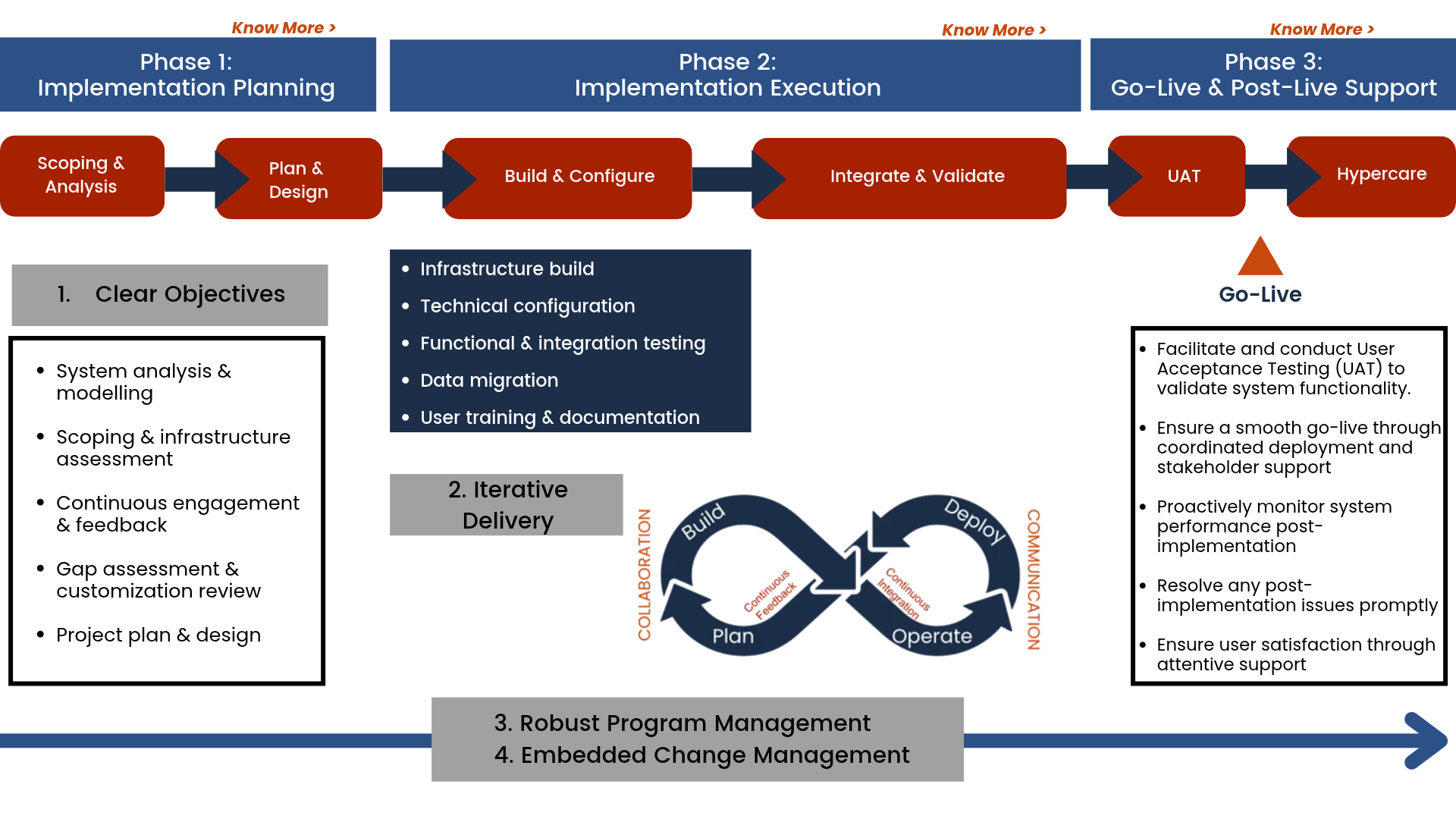
A good EnTrade implementation starts with a clear picture of where the business needs to end up, and a roadmap that actually reflects its priorities. Backed by deep functional, technical, and strategic expertise, Value Creed builds every deployment around the client’s needs, tests it properly, and makes sure it gets adopted.

vc-entrade-implementation

#1 Implementation Planning Phase

  • Audit the existing systems, workflows, and integrations.
  • Flag risks, redundant customizations, and cost drivers.
  • Deliver a gap analysis with recommendations the team can act on.
  • Map trading, risk, scheduling, and accounting to the relevant EnTrade modules.
  • Align the mapping with organizational goals and compliance requirements.
  • Define an architecture built for scalability, security, and compliance.
  • Put the latest EnTrade features to work optimizing processes.
  • Align the infrastructure with enterprise IT standards.
  • Build out structured plans by module and interface.
  • Align requirements, budget, and resourcing.
  • Set milestones and risk checkpoints.

#2 Implementation Execution Phase

1
System Implementation
Configure core modules, access controls, and custom workflows, follow a sprint-based development approach with regular feedback loops, and apply DevOps practices to ensure clean and reliable deployments.
2
Quality Assurance
Conduct manual and automated testing across core functionalities, integrations, and performance, validate real-world scenarios through UAT, and secure structured signoffs before go-live.
3
User Training & UAT
Provide role-based training with new feature demos. Deliver quick-reference guides and SOP manuals. Facilitate UAT with business user validation.

#3 Ensuring a Stable Go-Live

Go-Live & Hypercare

Execute the cutover through planned dry runs with a rollback strategy, provide 24/7 hypercare support with close post-go-live monitoring, and ensure minimal disruption to ongoing operations.

Post-Go-Live Support

Transition into RunSmart™ for continuous 24/7 monitoring, provide guidance on adopting new features, and support ongoing enhancements and future upgrades.

Business Outcomes of EnTrade Implementation with Value Creed

This approach makes day-to-day physical operations simpler and more efficient by reducing manual work, improving data accuracy, and giving teams better visibility across scheduling and operations. It brings complex processes into the ETRM environment, connects operational and enterprise systems more effectively, and creates room for future growth without adding to the workload or disrupting existing technology investments.

Less manual effort across scheduling and operational work

Better data accuracy and consistency, with less reliance on spreadsheets

Better connectivity between operational and enterprise systems

Clearer visibility into positions, nominations, variances, and actuas

vc-entrade-business-outcomes

Room to scale physical operations without scaling the manual workload

Stronger, more auditable operational controls

Complex physical structures managed inside a configurable ETRM

Modernization that protects the legacy investments already in place

Modernize physical operations with Value Creed

At the end of the day, physical gas scheduling is a business process problem before it’s a technology problem. Getting it right means understanding how commodities actually move, how pipelines and plants operate, how commercial agreements are structured, and how physical operations connect to the rest of the enterprise. Value Creed brings the commodity expertise, ETRM capability, integration experience, and implementation discipline to modernize physical gas operations while keeping the business running the whole time.

Recommended Resources

Ready to get started?

Explore our suite of solutions designed to empower your trading and risk management functions. Partner with us for a transformative CTRM experience that drives success in today’s ever-evolving markets.